The Honest, Step-by-Step Roadmap for Non-CS Graduates, Career Switchers, and Beginners to Break Into Java Development in 2026
How to Become a Java Full Stack Developer Without a Computer Science Degree
The Honest, Step-by-Step Roadmap for Non-CS Graduates, Career Switchers, and Beginners to Break Into Java Development in 2026
Here is something the traditional education system will not tell you.
Some of the most productive, highest-paid Java Full Stack Developers working at top companies today do not have a Computer Science degree. They have something more valuable — the right skills, real project experience, and the drive to learn deliberately.
In 2026, hiring managers at tech companies care about one thing above everything else: can you build? Can you write clean Java code, design a REST API with Spring Boot, connect a frontend to a backend, and deploy a working application? If the answer is yes, your degree — or lack of one — becomes largely irrelevant.
This guide is written specifically for people who are asking the question: can I become a java full stack developer without a CS degree? The answer is yes — but only if you follow the right path. Let's map it out.
Can You Really Become a Java Full Stack Developer Without a CS Degree?
This is the question most beginners are afraid to ask out loud because they fear the answer. So let's address it head-on with complete honesty.
The Degree Myth in Tech Hiring
The Computer Science degree was once the only accepted entry point into software development. That era is largely over. The explosion of bootcamps, online learning platforms, and project-based hiring has fundamentally changed how companies evaluate candidates — particularly at the junior and mid-level.
What changed? Companies started noticing that CS graduates often knew theory brilliantly but struggled with practical development tasks. Meanwhile, bootcamp graduates and self-taught developers with strong portfolios were delivering real value from day one. The result was a gradual but decisive shift toward skills-based hiring.
What Companies Actually Test For
When a company interviews a junior Java developer, they test for core Java fundamentals, the ability to build and explain a working project, understanding of Spring Boot and REST API concepts, basic database skills, and problem-solving ability through coding challenges. Notice what is not on that list — your degree, your college name, or your GPA.
Real-World Proof
Countless working Java Full Stack Developers started as commerce graduates, arts graduates, BBA holders, mechanical engineers, and even professionals from completely non-technical fields like banking, teaching, and sales. What they had in common was structured training, consistent practice, and a portfolio that demonstrated real ability. Java training without coding background is not just possible — it is increasingly common and well-supported by quality bootcamp programs.
The Step-by-Step Roadmap to Become a Java Full Stack Developer From Scratch
If you are starting from zero — no programming background, no CS fundamentals — this is the exact sequence you should follow. Each phase builds on the previous one, and skipping ahead creates gaps that come back to haunt you in interviews.
Phase 1 — Build Your Logic Foundation First
Before writing a single line of Java, spend two to three weeks building your logical thinking. Work through basic algorithmic problems — simple loops, conditionals, pattern problems — using pseudocode or even plain English. Understand what variables, functions, and loops actually mean conceptually. This phase feels slow but it dramatically accelerates everything that follows. Many beginners skip this and struggle unnecessarily when Java syntax feels confusing.
Phase 2 — Learn Core Java with Purpose
Now you are ready to write actual code. Start with Java syntax, data types, operators, control flow, and methods. Then move into object-oriented programming — this is the most important conceptual shift for any Java beginner. Understand classes, objects, inheritance, polymorphism, encapsulation, and abstraction not just as definitions but as design tools. Follow this with the collections framework, exception handling, and basic file I/O.
A quality java online course or classroom program will spend significant time here because this is the foundation everything else is built on. Do not rush it. Write code every single day during this phase.
Phase 3 — Enter the Spring Boot World
This is where things get exciting. Spring Boot is the framework that transforms raw Java knowledge into professional, production-grade backend development. In a structured spring boot classes program, you will learn how Spring Boot autoconfigures applications, how to build RESTful APIs with Spring MVC, how to manage security with Spring Security and JWT, and how to interact with databases using Spring Data JPA and Hibernate.
Build small projects as you learn each concept. A simple to-do API. A user registration and login system. A product catalogue backend. These micro-projects build your confidence and your portfolio simultaneously.
Phase 4 — Learn Frontend Fundamentals
Full stack means both sides of the application. You do not need to become a frontend expert, but you do need to be functional. Learn HTML5 and CSS3 first — these are the building blocks of every web interface. Then learn JavaScript fundamentals, which gives you the ability to add interactivity. Finally, move into React.js — understanding components, props, state, hooks, and how to connect your React frontend to a Spring Boot backend via API calls.
This combination — React on the frontend, Spring Boot on the backend — is the most commonly hired full stack pairing in the Java ecosystem right now.
Phase 5 — Master Databases and SQL
Every application needs data storage. Learn MySQL or PostgreSQL — write JOIN queries, understand indexing, practice normalisation. Learn how Hibernate and JPA map your Java entities to database tables, and understand how to handle transactions correctly. Weak database skills are one of the most common reasons otherwise capable candidates fail technical interviews.
Phase 6 — Add DevOps and Deployment Skills
In 2026, a Java Full Stack Developer who cannot push code to GitHub, containerise an app with Docker, or deploy to a basic cloud environment is leaving opportunities on the table. You do not need to become a DevOps engineer, but you need working knowledge of Git for version control, Maven or Gradle for build management, Docker for containerisation, and AWS basics including EC2, S3, and RDS.
Most good full stack development course programs now include these as standard modules rather than optional add-ons.
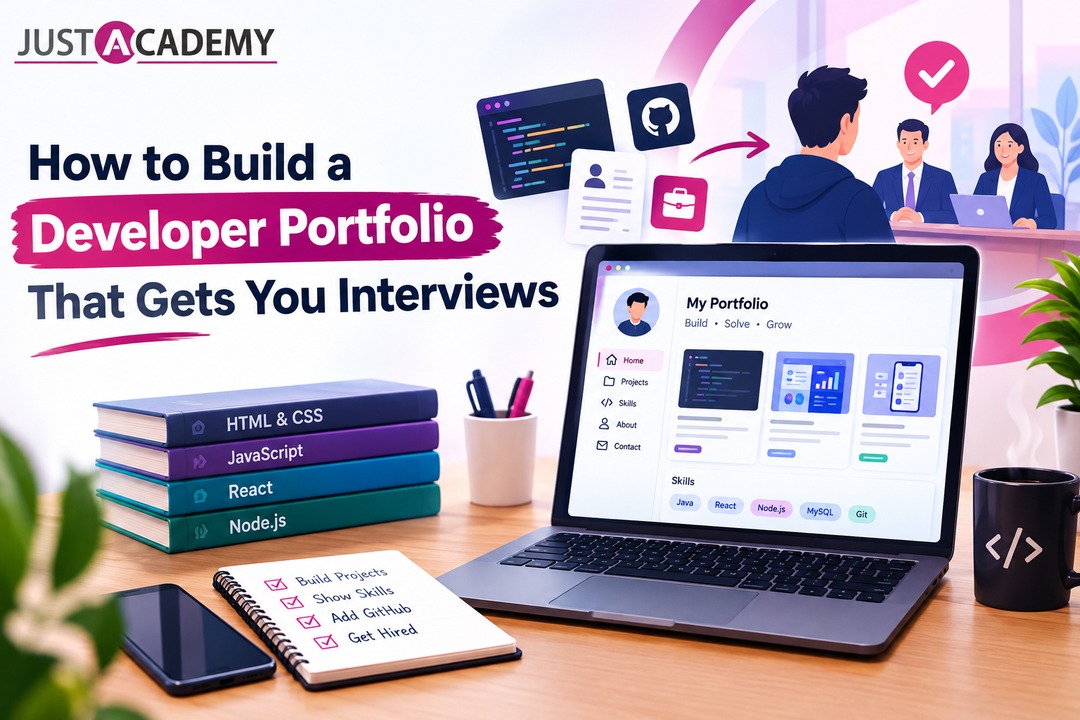
Phase 7 — Build a Portfolio That Gets You Hired
This is the phase that most self-taught developers underestimate. Your portfolio is your degree replacement. It is the evidence you present to employers in place of a CS diploma, and it needs to be compelling.
Build two to three complete, deployed applications. Not tutorial clones — original projects with genuine use cases. An expense tracker with user authentication. A job board with search and filter functionality. A booking system with email notifications. Put these on GitHub with clean READMEs, deploy them to the cloud, and be ready to walk an interviewer through every architectural decision you made.
Phase 8 — Apply, Interview, and Iterate
Start applying before you feel completely ready — because you will never feel completely ready. Apply to junior and entry-level roles, attend mock interviews, get feedback, fix the gaps, and apply again. The interview process itself is one of the fastest learning experiences available to a new developer.
What to Look for in a Java Online Course or Full Stack Development Course
With hundreds of java online course and full stack development course options available in 2026, the quality gap between programs is enormous. Here is how to evaluate them without getting misled by marketing.
Curriculum Depth Over Breadth
A course that claims to cover "50 technologies in 6 months" is almost always teaching everything superficially. What you need is depth — particularly in Core Java, Spring Boot, React, and databases. These four areas should consume the bulk of your learning time. Everything else is supplementary.
Project Work That Mimics Real Jobs
The best programs give you project briefs the way an actual employer would — here is the requirement, here is the tech stack, now build it. This is very different from following a step-by-step tutorial where every answer is handed to you. Struggle-based learning, guided by a mentor, is what builds genuine competence.
Spring Boot Classes That Go Beyond Basics
When evaluating spring boot classes, look for programs that cover not just basic CRUD operations but also Spring Security implementation, microservices concepts, exception handling at the API level, pagination and filtering, and integration testing. These are the topics that appear in real interviews at serious companies.
Mentorship Quality and Accessibility
Can you ask your instructor a question and get a thoughtful, experience-based answer within a reasonable timeframe? Good mentorship is not just about access — it is about the quality of guidance. An instructor who has built real production systems will answer your questions differently than one who has only taught from a syllabus.
Verified Placement Track Record
Any program can claim "100% placement." Ask for specifics. What companies have hired your graduates? Can I speak to someone who went through the program? What is the average time between course completion and first job offer? A program with a genuine placement track record will answer these questions confidently and transparently.
Java Full Stack Course for Beginners in Mumbai — Your Fastest Path to a Tech Job
If you are in Mumbai — or willing to train there — the structured bootcamp route dramatically accelerates your journey from beginner to employed Java Full Stack Developer compared to self-paced online learning alone.
Why Mumbai Is an Ideal City to Learn and Launch Your Java Career
Mumbai's tech ecosystem is uniquely dense. Major BFSI companies, global technology MNCs, and fast-growing product startups are all concentrated in areas like BKC, Andheri, Powai, and Thane. This means that while you are training, you are physically close to the companies that will eventually hire you — a proximity advantage that candidates learning remotely simply do not have.
Walk-in interview opportunities, networking events, referrals from instructors with industry connections, and the ability to attend in-person company assessments all become accessible when you train in the city where the jobs are.
For anyone looking for a java full stack course for beginners in mumbai or a comprehensive java training without coding background, the JustAcademy Full Stack Java Developer Bootcamp is built precisely for this audience.
The program starts from absolute basics — no prior programming experience required — and takes you through Core Java, Spring Boot, React, databases, DevOps fundamentals, and real project development in a structured, mentor-guided environment. The curriculum is designed not around what is theoretically comprehensive but around what actually gets Java developers hired.
What makes the bootcamp particularly effective for non-CS beginners is the classroom environment. Live doubt resolution means you are never stuck on a concept for days the way self-learners often are. Peer learning creates accountability. And the structured schedule prevents the procrastination that kills most self-paced learning attempts.
Beyond the training itself, the placement cell actively works to connect graduates with hiring partners — mock interviews, resume reviews, LinkedIn optimisation, and employer introductions are all part of the program.
Explore the Full Stack Java Developer Bootcamp — Online Live Interactive Training
Not sure if this is the right fit? Register for a free demo and experience the teaching style, meet the instructors, and evaluate the curriculum before making any commitment.
Register for a Free Demo — Zero Commitment Required
Explore More Bootcamps at JustAcademy
If you are exploring adjacent tech career paths alongside Java full stack development, JustAcademy offers several other high-quality bootcamps worth considering.
For those drawn to data-driven careers, this bootcamp covers Python, SQL, Power BI, Excel, and machine learning fundamentals with real-world datasets and project work.
A strong option for those interested in software quality and testing. Covers Selenium, TestNG, Postman, API automation, and CI/CD pipeline integration with end-to-end project work.
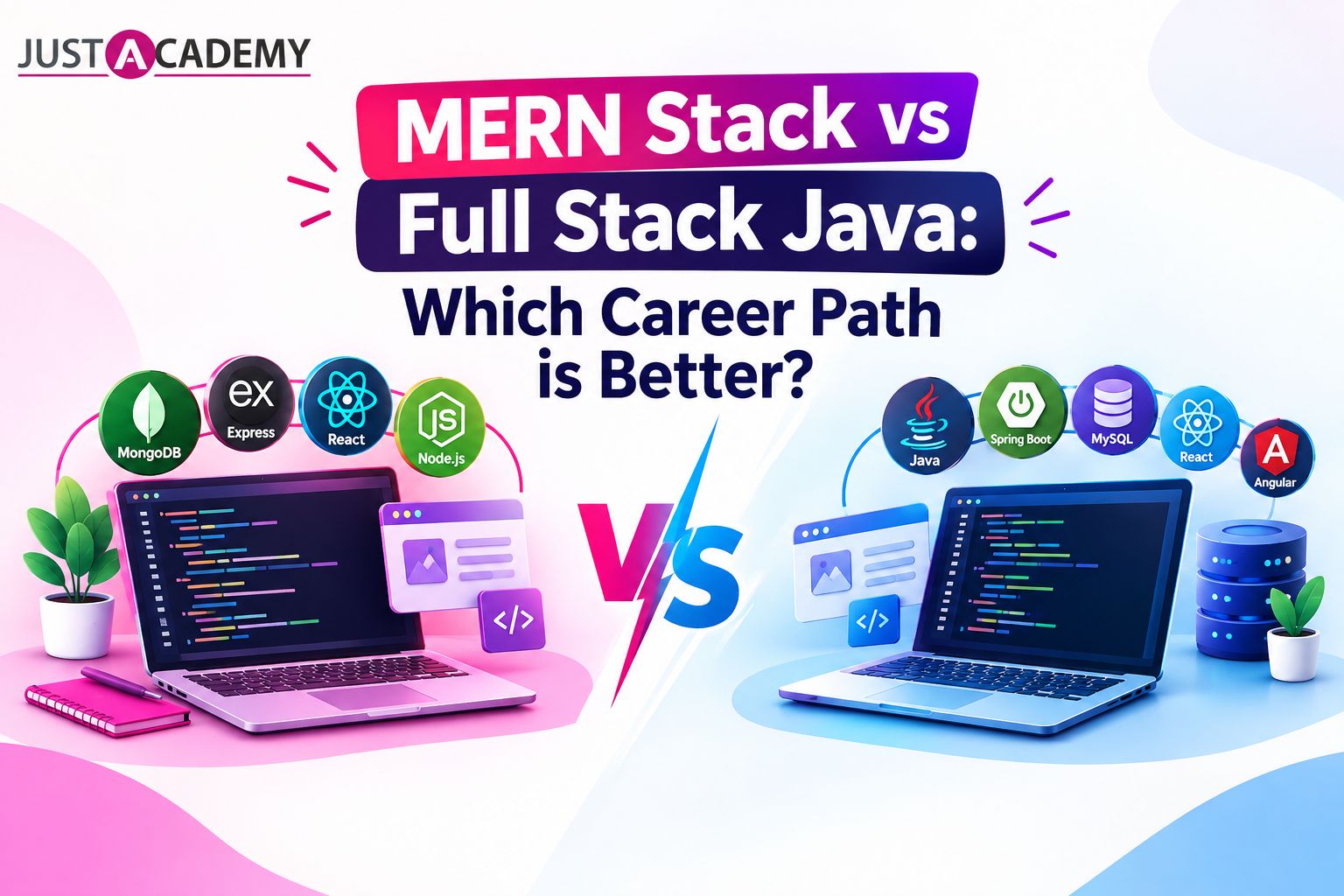
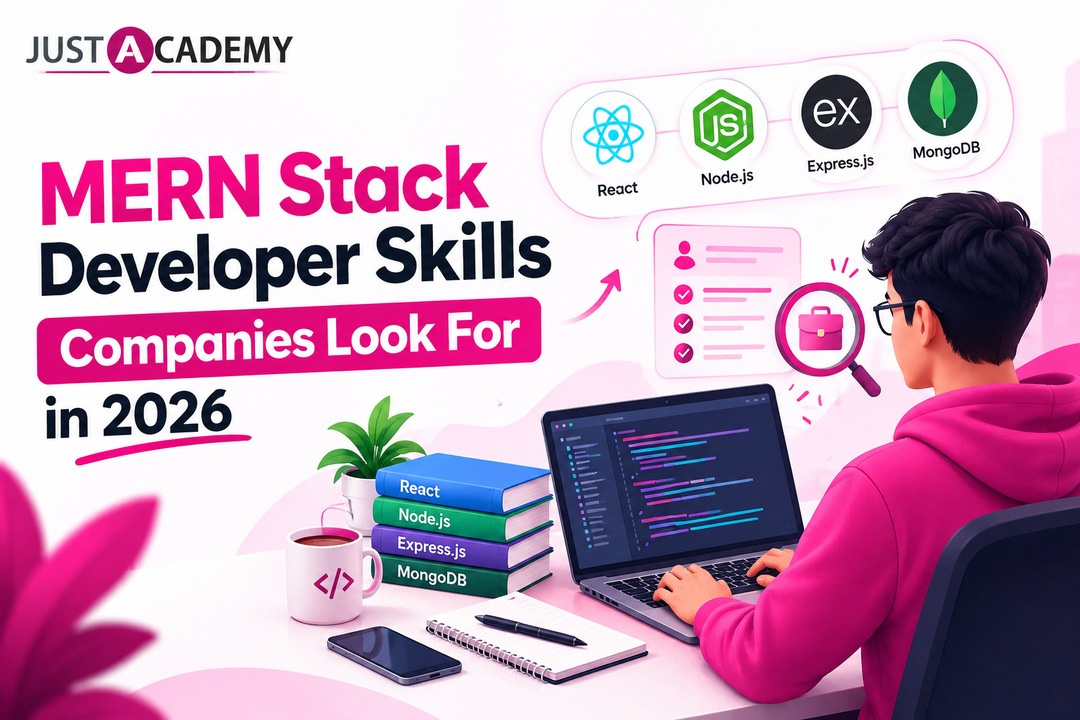
For those who want to work in the JavaScript ecosystem, this bootcamp covers MongoDB, Express.js, React.js, and Node.js — the complete MERN stack — with live interactive training and placement support.
The Bottom Line — Your Degree Does Not Define Your Ceiling
The path to becoming a Java Full Stack Developer without a CS degree is real, well-travelled, and increasingly supported by quality training programs that are designed specifically for beginners and career switchers.
What it requires is not a particular educational background. It requires the right curriculum, consistent daily practice, hands-on project experience, and a placement-focused program that bridges the gap between learning and landing your first role.
In 2026, the demand for Java Full Stack Developers is at record levels. Companies are hiring. Salaries are strong. And the developers who are going to fill those roles are not waiting for the perfect moment — they are starting today, from wherever they are.
The only real question is whether you are going to be one of them.
Can You Really Become a Java Full Stack Developer Without a CS Degree?
The Step-by-Step Roadmap to Become a Java Full Stack Developer From Scratch
What to Look for in a Java Online Course or Full Stack Development Course
Java Full Stack Course for Beginners in Mumbai — Your Fastest Path to a Tech Job